Why are Florida families leaving public schools?
Florida families are leaving public schools because the state has defunded them for decades. Florida ranks 50th of 51 for average teacher pay and 8th lowest in per-pupil spending, while a 2023 universal voucher law now routes billions away from public classrooms. David Jolly's position is that public schools were abandoned by policy, not by parents, and a 10-year renaissance in funding can bring families back.[1]
The short answer, at a glance
Pay drove teachers out
Florida's average teacher salary of $56,663 ranks 50th of 51, more than $17,800 below the national average, and left roughly 5,000 classrooms unfilled to start the 2024-25 year.[1][2]
Vouchers drained the pool
A 2023 universal voucher law now sends about $3.9 billion through the same funding formula public schools depend on, mechanically shrinking their per-pupil support.[3][4]
Jolly's fix: fund, don't abandon
David Jolly proposes a 10-year renaissance: pay teachers dramatically more, build more public schools, and reform vouchers so they serve families in need, not existing tuition payers.[5]
What is actually happening
The number is real. Florida public school enrollment was about 2.81 million students in FY 2024-25, and the state's own estimating conference projects a drop of more than 70,000 students by 2029-30.[6] The easy story is that parents lost faith in public schools. But for families across Florida, it goes deeper than that. This isn't a story about parents walking away. It's a story about a system that was defunded until walking away started to look like the only choice.
Florida spends roughly $12,400 per pupil, 8th lowest among the states, and earned an "F" for school spending on Education Week's most recent national report card.[7] That underfunding is not a bad budget year. It is the through-line of decades. As David Jolly puts it, public schools have been inadequately funded in Florida for decades, and some communities now look for a public school and find there isn't one.[5]
The teacher pay driver
When teachers leave, families follow. Florida's average teacher salary of $56,663 ranks 50th of 51 states, more than $17,800 below the national average of $74,495.[1] Only Mississippi is worse. Starting pay ranks a respectable 19th, but mid-career and veteran pay falls dramatically behind Georgia, Alabama, and North Carolina, so Florida recruits teachers and then loses them.[8] The result showed up on the first day of the 2024-25 school year: nearly 10,000 vacant positions statewide, including 5,007 unfilled teaching jobs, with the deepest gaps in special education, math, and science.[2] The teachers who stay, Jolly says, do it out of love, commitment, and passion for the craft.[9] Love should not have to cover for pay.
The voucher drain
The other driver is structural. The 2023 Family Empowerment Scholarship law (HB 1) made vouchers universal regardless of income, and Florida spent about $3.9 billion on voucher and scholarship programs in FY 2024-25.[3] Roughly $2.8 billion of that flows through the Florida Education Finance Program, the same per-student formula that funds public schools, so every voucher dollar mechanically lowers what public-school students receive.[4] And it isn't reaching the families it promised. About 69% of new voucher recipients after the 2023 expansion were already enrolled in private schools.[3] As Jolly says, when schools take a voucher but charge tuition on top of it, we are abandoning the very families school choice was supposed to help.[9] This isn't parents choosing to leave. It's a public system being quietly drained while a private one is subsidized.
What David Jolly would do
The plan is to make public schools worth choosing again. David Jolly proposes a 10-year renaissance in public education: dramatically increase investment, build more public schools in more neighborhoods, and pay more teachers more.[5] One funding lever he names is reallocating a portion of Tourist Development Tax revenue, currently restricted by statute to tourism uses like convention centers, toward teacher pay and school infrastructure.[10] Florida, he argues, does not have a crisis of convention centers. It has a crisis of public education. On vouchers, his position is reform, not repeal: cap tuition inflation, require voucher schools to provide the same specialized services public schools provide, and means-test the program for families in genuine need.[11] His bet is simple. If Florida builds a world-class public system, families will choose it in a school choice environment.[9]
This one question is a piece of a larger plan. For the full public education agenda, see the campaign's main education page. Read the full plan on public education.
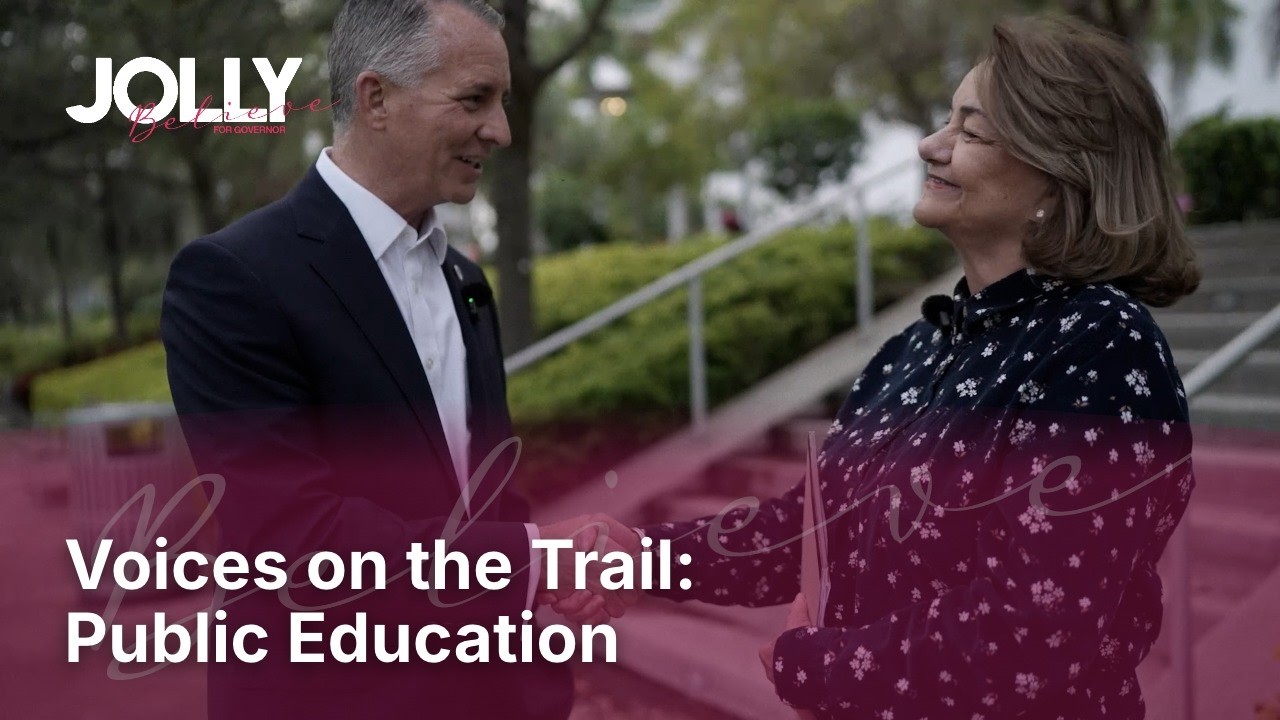
A conversation with a 40-year Miami-Dade educator on why school choice has become a false choice for Florida families.
Frequently asked questions
Q. Why are so many teachers leaving Florida?
Florida public schools opened the 2024-25 school year with nearly 10,000 vacant positions, including 5,007 instructional (teacher) positions. The largest district vacancies are in Hillsborough (742), Broward (606), and Palm Beach (490). The structural cause is pay: Florida's average teacher salary of $56,663 ranks 50th of 51 nationally, only Mississippi is worse. Florida's starting salary ranks 19th (decent), but mid-career and veteran pay falls dramatically behind peer states. Teachers report low pay, high cost of living, and Florida's political climate (HB 1557, book restrictions, Stop WOKE Act) as reasons to leave the profession or the state.[1][2]
Q. What if I have kids in Florida public schools?
Public school enrollment in Florida fell during the universal voucher expansion: about 2.81 million students in FY 2024-25, projected to drop more than 70,000 by 2029-30. Class size and program offerings have been affected by the FEFP funding reductions that voucher uptake triggers. Jolly's plan would restore funding pressure on public schools through increased appropriations and TDT reallocation, raise teacher pay to retain experienced instructors, and reform the voucher program's structural drain on FEFP. The 4th-grade math strength (FL is 3rd nationally) remains, but Jolly's plan aims to extend that success into 8th grade and reading where Florida has been declining.[6][12]
Q. Isn't school choice good for parents?
School choice as a principle has broad support. The question is how it's structured. Florida's universal voucher program (HB 1, 2023) gave every family, regardless of income, access to public dollars for private school. The result: about 69% of new voucher recipients after the 2023 expansion were already enrolled in private schools, meaning the program is largely subsidizing existing tuition payers rather than expanding access for kids who couldn't afford private school before. Jolly's reforms would preserve school choice as access, keeping vouchers for families who need them, while removing the universal subsidy for higher-income families using vouchers to reduce existing tuition costs.[3]
Q. Don't vouchers help low-income families afford private school?
The original FES program (pre-2023) was targeted at low-income families and worked as intended for that population. The 2023 universal expansion removed income limits, and the result has been heavily skewed toward families already in private schools. About 69% of new voucher recipients after HB 1 were already enrolled in private schools, meaning the expansion functioned as a tuition subsidy rather than expanding low-income access. Jolly's means-testing reform would restore the targeting to families who actually need the program to access private school, the use case the original voucher framing promised to serve.[3]
Q. How are Florida public schools funded?
Florida K-12 public schools are funded primarily through the Florida Education Finance Program (FEFP), a per-student state allocation paid to school districts with adjustments for special programs (special education, ESOL, vocational). The total funding pool combines state appropriations, local property tax revenue from school districts, and federal funds (Title I, IDEA). Florida's per-pupil spending is approximately $12,400, ranking 8th lowest among U.S. states, and Florida earned an "F" for school spending in Education Week's most recent Quality Counts National Report Card.[7][4]
Q. What about rural Florida school districts?
Rural Florida districts face a compounding crisis: shrinking enrollment, fewer private-school options nearby (so vouchers help less), higher per-pupil costs (fewer students to spread fixed costs across), and the most acute teacher shortages. Florida's teacher shortage is most severe in special education, English, science, and math, exactly the subjects rural districts have the hardest time staffing. Jolly's plan to raise teacher pay statewide would help rural districts compete for instructional talent. Expanded state funding through FEFP would also help rural districts maintain operations as enrollment declines drag local property tax bases down.[2][4]
Q. Doesn't Florida already have great 4th grade math scores?
Yes, Florida's 4th-grade math NAEP performance ranks 3rd nationally and is a genuine bright spot. The structural question is what happens between 4th and 8th grade. Florida's 8th-grade math score declined significantly from 2022, making Florida one of only four states with a significant decline; Florida's 8th-grade math mean is now lower than Mississippi's. Achievement gaps for Black, Hispanic, and economically disadvantaged Florida students have not narrowed even as 4th-grade math has improved. The pattern suggests early-grade gains aren't being sustained through middle school, which Jolly's "10-year renaissance" framing aims to address by reinvesting in middle and high school programming, not just early-grade reading and math.[12]
Q. What is Jolly's "10-year renaissance" plan?
"Public schools have been inadequately funded in Florida for decades," Jolly says. His proposed renaissance has three components: dramatically increase investment in public schools, build more public schools in more neighborhoods (especially in growth areas where capacity has not kept pace with population), and pay more teachers more. The 10-year framing is deliberate, Jolly treats this as a generational investment rather than a one-cycle budget fix. The TDT reallocation is one funding lever; growing state appropriations to FEFP is another. The aim is to reverse decades of structural underfunding.[5]
Q. Does Jolly want to eliminate vouchers entirely?
No. Jolly's position is structural reform of the voucher program, not elimination. The three changes he proposes, tuition inflation caps, equivalent specialized services, and means-testing, would still leave a functioning voucher program for low-income families who genuinely need school-choice options. The reforms target the dynamics that turn universal vouchers into a tuition subsidy for families who were already in private school (about 69% of new voucher recipients after the 2023 expansion). The goal is to make voucher dollars do what they were originally promised to do: expand access for kids who otherwise couldn't attend private school.[11][3]
Q. How much do Florida vouchers cost the state?
Florida spent approximately $3.9 billion on voucher and tax-credit scholarship programs in FY 2024-25, $2.8 billion in FEFP-funded vouchers plus $1.1 billion in tax credit scholarships. The Florida House's original fiscal impact analysis for HB 1 (2023) projected $209.6 million in annual cost. Actual spending is roughly 19 times that projection. The Florida Policy Institute and Education Law Center had projected approximately $4 billion based on accurate modeling of student migration, they were right; the House analysis was not. This trajectory is the basis for Jolly's framing that the voucher program is "built on an economic model that is likely to collapse."[3][13]
Q. What about students with disabilities?
Special-education classrooms have the largest teacher vacancies in Florida, the FEA identifies students with disabilities as the area of greatest need. The voucher program's structural problem for special-needs students is that voucher-accepting private schools are not required to provide the same special-education services that public schools must legally deliver. A parent of a child with disabilities who uses a voucher to leave public school often loses the special education service plan (IEP) and accommodations their child needs. Jolly's reform requiring private voucher schools to provide the same specialized services would close that gap.[2][14]
Q. What if I am a teacher in Florida?
Florida teachers face below-average pay (average $56,663 vs $74,495 national), continued pressure from curriculum restrictions (HB 1557, Stop WOKE Act, book challenges), and a public-school enrollment decline that is driving class consolidation and district layoffs. About 5,000 teaching positions sit unfilled statewide. Jolly's plan would target the central pay issue through TDT reallocation and FEFP increases, and review the climate of curriculum restrictions that have been driving attrition. The plan also requires private voucher schools to meet the same standards public school teachers operate under, which closes one path teachers had been taking to leave public school employment.[1][2]
Sources
- National Education Association, Educator Pay Data 2026, https://www.nea.org/resource-library/educator-pay-and-student-spending-how-does-your-state-rank/teacher · 2026-04-01
- Florida Education Association, Teacher Shortages, https://feaweb.org/issues-action/teacher-shortages/ · 2024-08-16
- Florida Senate, HB 1 (2023), https://www.flsenate.gov/Session/Bill/2023/1 · 2023-03-27
- Florida Department of Education, FEFP, https://www.fldoe.org/finance/fl-edu-finance-program-fefp/ · 2024-01-01
- David Jolly for Florida, Saving Our Schools, https://davidjolly.com/saving-our-schools · 2024-01-01
- Florida Department of Education, Education Data Warehouse, https://www.fldoe.org/accountability/data-sys/edw/ · 2024-10-01
- Education Week, Quality Counts, https://www.edweek.org/policy-politics/quality-counts · 2024-01-01
- National Education Association, Rankings of the States 2026, https://www.nea.org/resource-library/educator-pay-and-student-spending-how-does-your-state-rank · 2026-04-01
- David Jolly, Education Interview (Miami-Dade educator), https://www.youtube.com/watch?v=hnqb9QDZ32o · 2026-03-23
- Florida Department of Revenue, Local Option Tourist Tax, https://floridarevenue.com/taxes/taxesfees/Pages/local_option.aspx · 2025-01-01
- David Jolly for Florida, Saving Our Schools (voucher reform), https://davidjolly.com/saving-our-schools · 2024-01-01
- NAEP Nation's Report Card, Florida, https://www.nationsreportcard.gov/profiles/stateprofile?chort=1&sub=MAT&sj=FL · 2024-10-01
- Florida Policy Institute, Universal Voucher Cost Analysis, https://www.floridapolicy.org/posts/universal-voucher-program-under-hb-1-would-cost-billions-analysis-finds · 2023-03-01
- Florida Department of Education, K-12 Scholarship Programs, https://www.fldoe.org/schools/school-choice/k-12-scholarship-programs/ · 2024-01-01
Families didn't leave. They were pushed out.
Public schools were abandoned by policy, not by parents, and a decade of real investment can bring families back. Have a question for David? Visit the Town Hall and ask.